

Foraging for Hazelnuts

Native to the UK and common across the country, Hazel trees are an essential part of the English countryside and provide essential Winter nutrients for wildlife and foragers. These tasty little nuts might take a long time to grow, but are definitely worth the wait.
Taking much of the year to grow and appearing as if from nowhere, Hazelnuts provide essential Winter nutrients for foragers and wildlife alike. Native to the UK and commonly found throughout the country, they thrive in hedgerows and woodlands where they are often found growing together in groves where they have been intentionally planted or helped along by the local Squirrel population.
Whilst Hazelnuts are not our only edible UK native, they are the easiest to gather and need little in the way of processing to make them edible, unlike Acorns and Beech nuts. Hazelnuts can be eaten raw, and stored in their hard shells for long periods of time, making them a wonderful store cupboard staple that can be used in a multitude of different ways.
Hazelnut, or Corylus avellana

How to Identify Hazelnuts
Our native Hazel, Corylus avellana, is easily idenitified by its unusual growing habits; rather than producing one main solid trunk as we are used to seeing on most other trees, the Common Hazel instead continues to produce branches from the base, or 'stool', or the tree, giving it a more shrub-like appearance. This alone makes it very easy to spot and distinguish in woodlands, even in the depths of Winter.
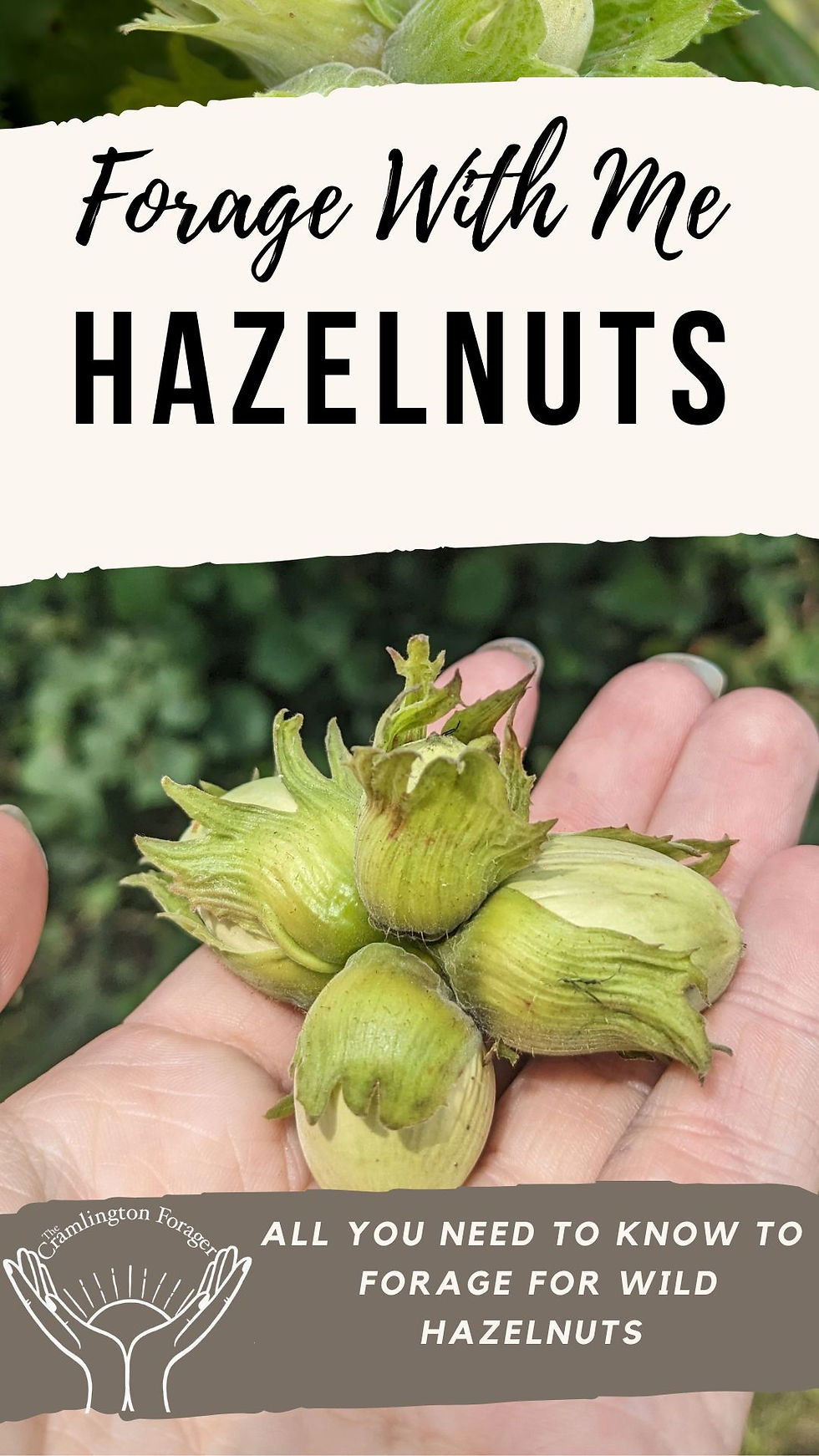
Their leaves are green and oval in shape, with double-toothed serrated edges, and the underside is coated in fine hairs. From Autumn the tree begins to grow next year's catkins, the male flower, which typically open around mid-February. They start off small and cylindrical in shape, tightly closed and waiting for Spring, when they will elongate and open, ready to release their pollen. Hazel trees are cleverly adapted to be wind pollinated to make sure their flowers are pollinated during the time of year when most pollinators are still dormant. The pollen from the male catkins, fertilises the tiny red female flowers, which then develop into Hazelnuts. From pollination to harvest, its takes around six months before we begin to see the ripe nuts falling from the trees. The nuts are oval in shape, and wrapped in an outer papery husk. Both the shell of the nut and the husk start off green and darken to brown once the nut is ripe and ready to eat. They can be found growing clusters of upto four, or as individual nuts.

When to Forage for Hazelnuts
Hazelnuts typically begin to ripen around late August, but won't be fully ripe until late September/early October. However, if you wait until the nuts are brown to head out with your foraging basket, the chances are high that you won't find any at all! Squirrels, mice, birds and deer are all quite partial to Hazelnuts and have a fine sense as to when they are perfect for eating, or caching away for Winter. Most of our wild neighbours will eat the nuts whilst they are still soft and green, whereas we tend to favour them more as hard, brown nuts, which means you are unlikely to find any if you wait until they are ripe.
Luckily, the nuts can be gathered whilst they are still green and ripened at home from around the beginning of September, as the husks and shells are starting to yellow. Be sure to store them in a breathable container such as a basket, cardboard box or cotton bag, to prevent them from going mouldy as they ripen, particularly if they are still in the husks. After a few days, the husks will dry and the nut will fall out, after which the husks can be discarded and the nuts will continue to ripen.

Sustainable Foraging
Whilst they are a common tree throughout the UK, and in a good year a single mature tree can provide hundreds of nuts, Hazelnuts are an essential Winter food source for wild birds and mammals and its important that we forage for them mindfully and sustainably by following a few simple guidelines:
While they often grow in great abundance, it's important to only gather from areas that have a plentiful supply. Never strip an area completely.
Gather gently and try to avoid breaking branches as this can cause lasting damage, and leave the tree open to disease.
I'm a big advocator for foraging a little and walking a lot - moving from tree to tree and gathering small amounts rather than large amounts from one tree. This not only leaves plenty for the wildlife who rely on Hazelnuts for food during the Winter, but also for other foragers who might also pass through the same area.
Never gather more than you can make use of. Wild food should not go to waste.
Hazelnut Lookalikes
There are no known lookalikes for Hazelnuts, edible or poisonous, which makes them a safe and easy option for novice foragers. There are a number of different varieties of Hazelnuts such as the Turkish Hazel and the Filbert Hazel, but they all produce edible nuts.
Hazelnut Recipes
If left in their hard shells, Hazelnuts can be stored for for upto 12 months in a cool, dry place. They should be checked regularly for signs of mould, but if they have been ripened correctly, it shouldn't present any problems. Once they have been shelled, they should be eaten as soon as possible. Their long shelf life makes them a very useful wild edible to gather and have on hand in the store cupboard, as does their wonderful versatility. They can be used in a multitude of different ways, from making nut butters and spreads, to nut loafs and pestos, or simply enjoyed just as they are, they lend themselves well to both sweet and savoury dishes. For a classic flavour combination, try pairing roasted Hazelnuts with chcolate in cakes, desserts, spreads (Nutella!) and other sweet treats.


Comments